# Installation Manuals
true-Broker installation manuals
# Installation Manual V-5.1.0
[](pdfgenerator=eyJ0aXRsZSI6IFsidHJ1ZS1Ccm9rZXIiXSwgInN1YnRpdGxlIjogWyJJbnN0YWxsYXRpb24gTWFudWFsIFYtNS4xLjAiXSwgInZlcnNpb24iOiAiNS4xLjAifQ==)
# Overview
true-Broker enables UBS customers to automatically exchange data with B2B applications of UBS over the Internet. true-Broker Web is responsible to establish a secure communication with the UBS Web-Portal. The communication is secured using 128bit SSL/TLS with mutual certificate based authentication.
true-Broker Web is a Web application running on an Apache Tomcat server.
true-Broker Web is multi-client capable. true-Broker Web Administration may be used to manage the client instances of true-Broker Web. For each client a specific true-Broker Web application instance is deployed on Apache Tomcat which separates it from the other clients.
The configuration of each true-Broker Web client instance is held in an internal data base.
true-Broker Web additionally offers a Web service interface for real time message exchange. The supported operations of the Web service interface are:
- Check the connection to the target system
- Transfer message from the client system to the target system
- Check the status of a sent message
- Receive a message from the target system
## System Requirements
Operating systems
- Recent Windows OS (Server or Desktop)
Software
- true-Broker Web 5.0.x or newer
Hardware
- 20 GB free hard disk
- 8 GB RAM
Other
- Administrator rights
- https access to the Internet (proxy configuration parameters if required)
- Unbound local port 8645/8646
- Firewall allowing connections to [http://localhost:8645](http://localhost:8645) and/or [https://localhost:8646](https://localhost:8646)
# Installation
a) Download true-Broker Web from the release section of this site.
https://products.sits.services/books/true-broker/chapter/releases
b) Install true-Broker Web by running the downloaded installer. To connect to UBS you require at least version 5.0 of true-Broker. The version is displayed at the bottom-right corner in true-Broker Web.
# Configration
## Add a client
Once the software is installed, you can start with the configurtaion of it as per the steps below:
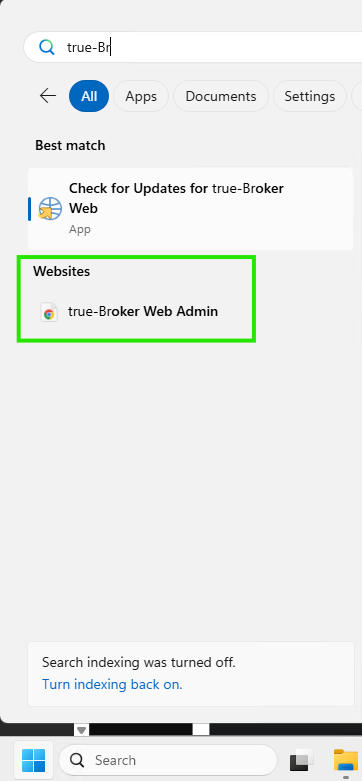
a) Open true-Broker Web Admin via Start →
*Programs* → *keyon* → *true-Broker Web Admin*
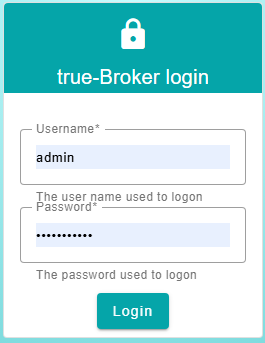
b) Login with user name 'admin' and Password = '12345678', click *__Login__*
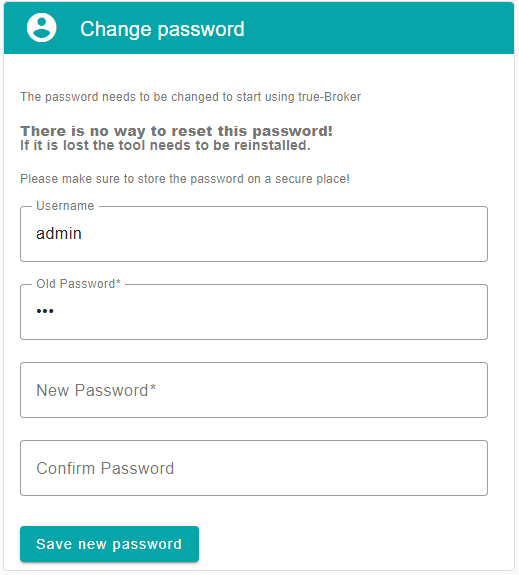
c) true-Broker requires you to change the password after the first login. Please be aware that the passort __cannot be reset!__ It is __your responsibility__ to store the password in a secure place.
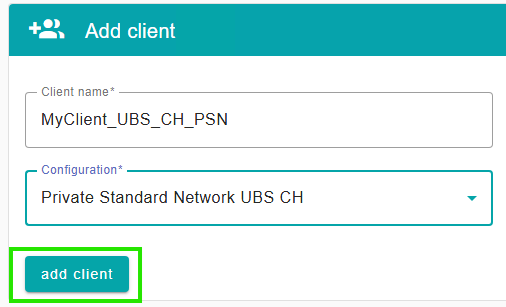
d) Add client by entering a client name and it's booking center (e.g. MyClient_UBS_CH_PSN) __Do not use any whitespaces in the name__.
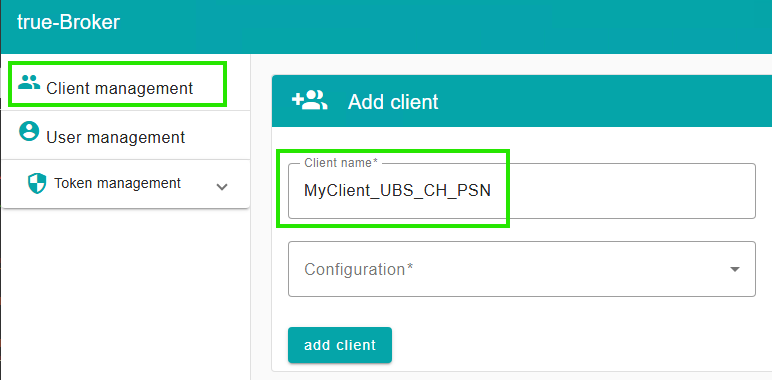
e) Choose the correct Configuration based on where your accounts are booked.
For example:
- UBS Switzerland booked accounts:
- Private Standard Network UBS CH
- UBS Luxembourg booked accounts:
- Private Standard Network UBS EMEA - LUX
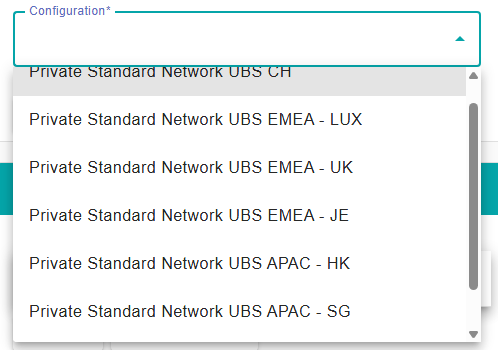
f) Click *__Add client__* and wait for one minute for the client to be deployed.
g) Restart the windows service (TrueBrokerWeb) afer the client was added.
## Configure the client
a) Open the client by clicking on the client name
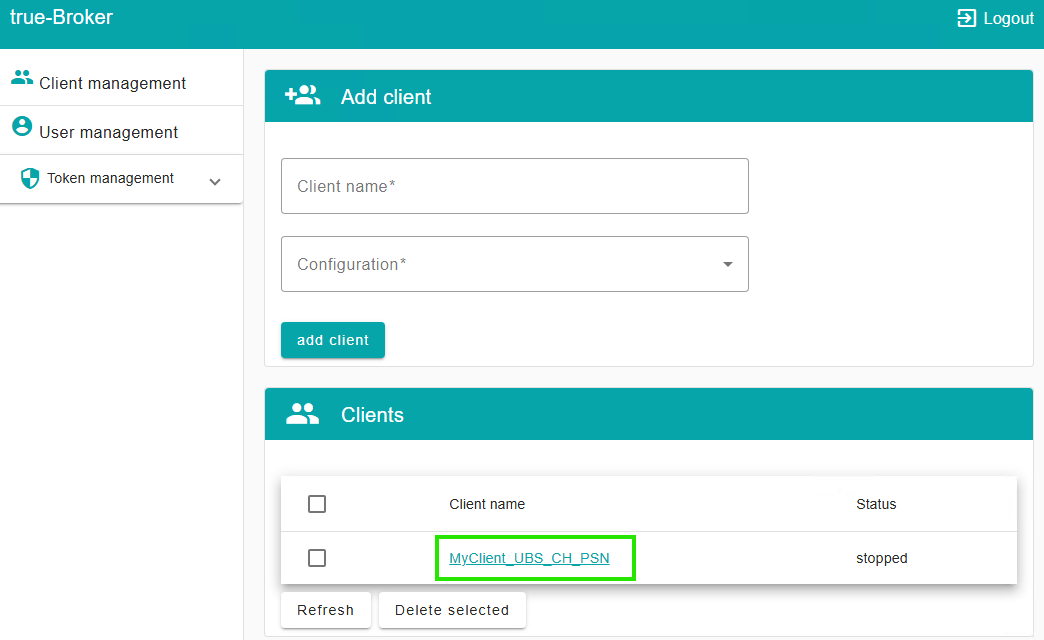
b) Login with user name = admin and your password, click *__Login__*

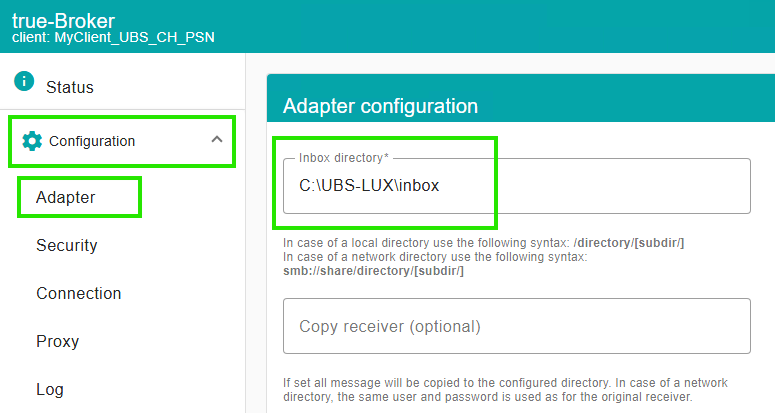
c) Configure download path by clicking Adapter, at Inbox directory set the path to an existing directory (e.g. C:\UBS-CH\inbox), then click *__Save__*
## Create the certificate
a) Configure security by clicking *__Security__*, select the appropriate Library:
- SoftToken
then click *__Load Library__*
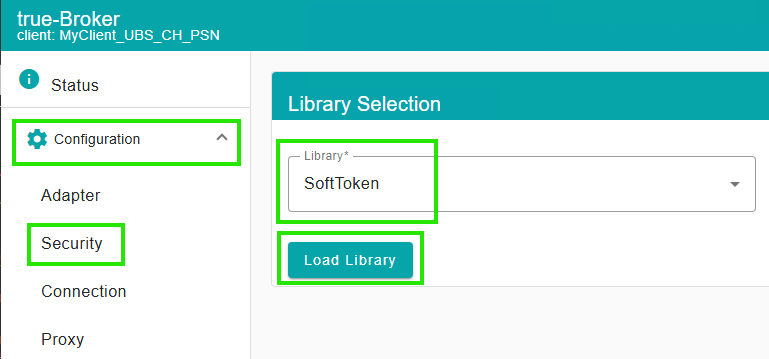
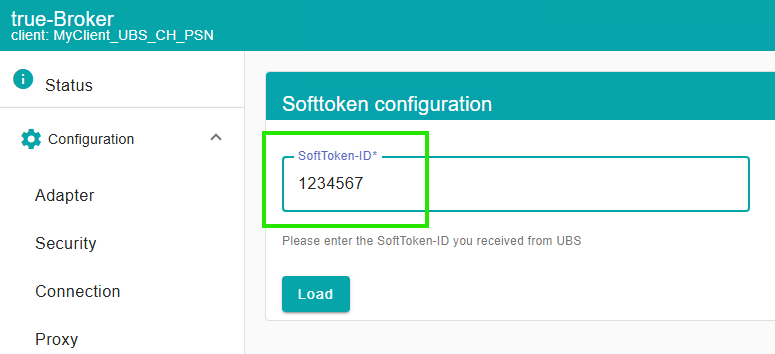
b) Enter Contract-ID which you received by mail from UBS, then click *__Load__*.
Example UBS-Contract-ID: __12345678__
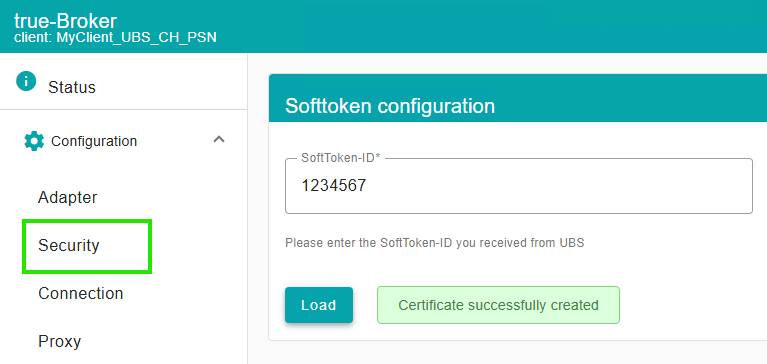
c) Click again on *__Security__* to display the generated certificate
d) Send the created Certificate to UBS. You can find it at the bottom of the Security page. Copy it, save it as a .txt file (you can use Notepad for this) and send it to: sh-psn@ubs.com
__Do NOT send the thumbprint via mail__
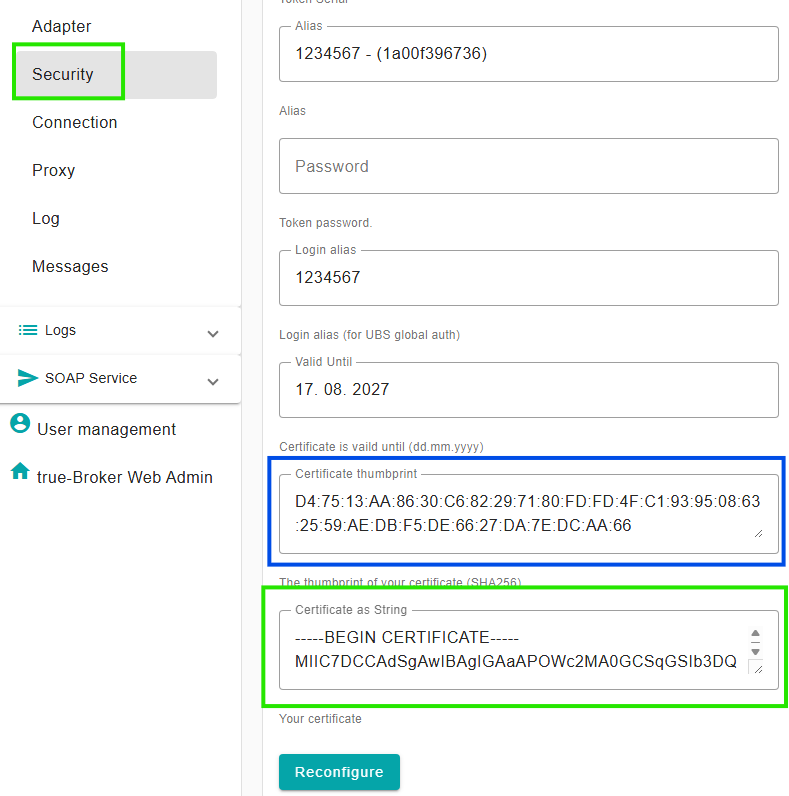
UBS now needs to register your newly created certificate on their side. For this you must schedule a call with the team
(sh-psn@ubs.com). During this call, you share the thumbprint of your certificate with UBS. The thumbprint of your certificate is listed under Security, directly above your certificate. (Marked in blue)
## Test and start your client
a) Open the client by clicking on the client name

b) Login with username 'admin' and your password, click *__Login__*

c) Run Configuration Test by clicking *__Status__* on the left, then click *__Test__*
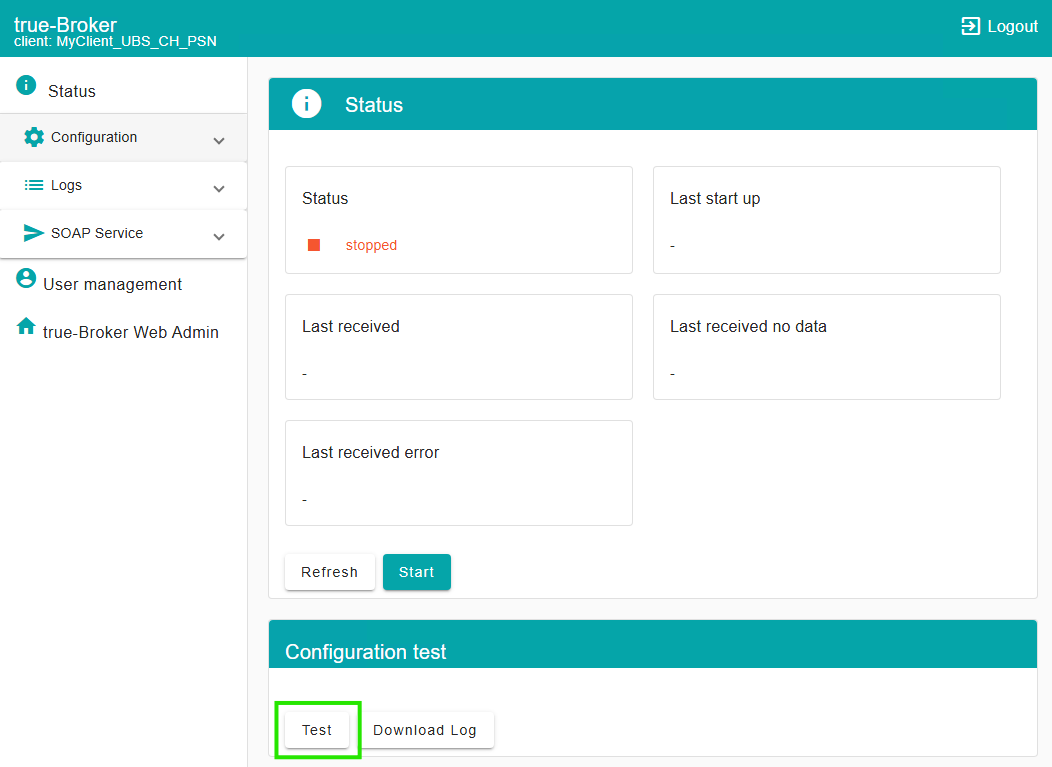
d) Start the client by clicking *__Start__* (once the connection test was successful)
Done!
Your downloaded files will now be saved in the configured directory
# Troubleshoot
If the connection is not working as expected, please execute the test as described above. Then check the error which is shown.
## Contract unknown
The test is not successfull and shows below error: __Contract__ unknown
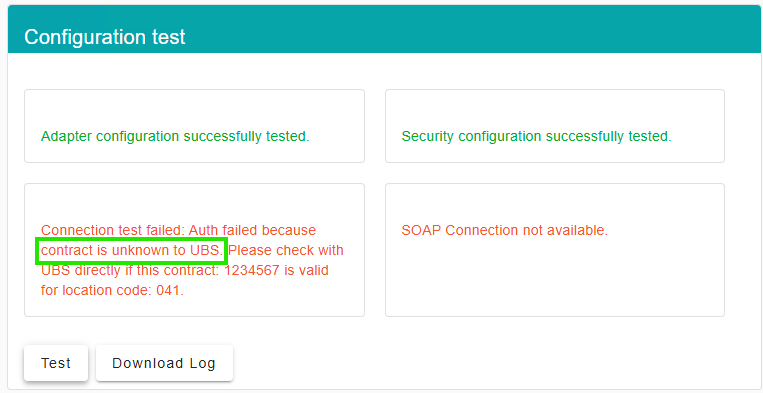
The above error means, that either your contract number is wrong or you have chosen the wrong booking location. Please double check that the contract number is correct and that you have chosen the right location. The Booking Codes mentioned in the error are mapped as per below table. If you are unsure what to choose, please contact your client advisor of UBS to clarify it.
| Location | Code |
|----------------|------|
| Hong-Kong | 030 |
| Jersey | 036 |
| Luxembourg | 041 |
| Singapore | 046 |
| Switzerland | 001 |
| United Kingdom | 023 |
## Certificate unknown
The test is not successfull and shows below error: __Certificate__ unknown
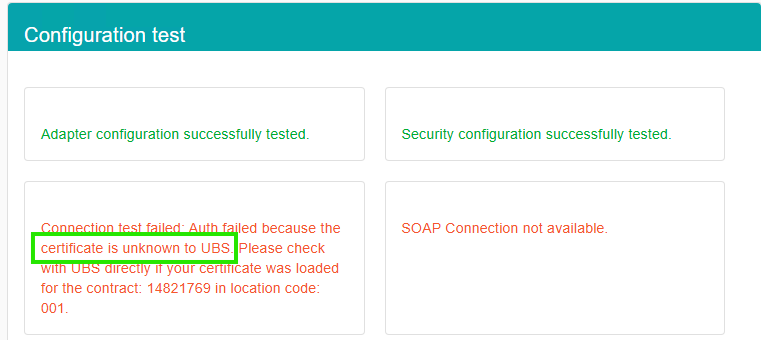
The above error means, that UBS did not yet load your certificate on their side. Please wait until you receive the confirmation from UBS that your certificate was activated. After that, the test should result in a success.
# Support
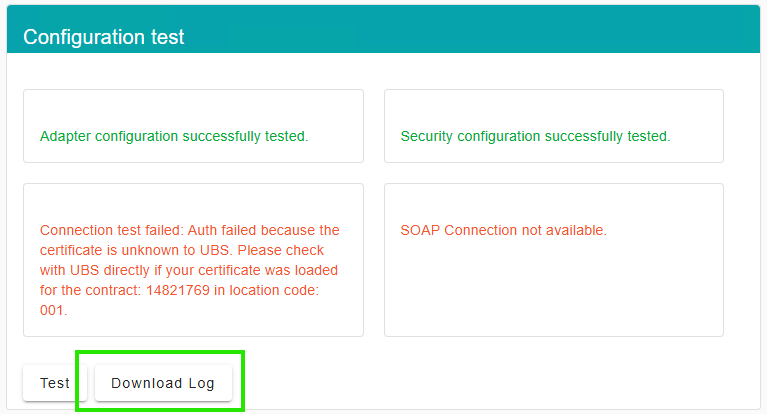
In case you see a different error or you need furhter assistance. Please *__download__* the log file of the test as per the screenshot below and provide it to our support team at: servicedesk@sits.com
# Installation Manual Linux V-5.1.0
[](pdfgenerator=eyJ0aXRsZSI6IFsidHJ1ZS1Ccm9rZXIiXSwgInN1YnRpdGxlIjogWyJJbnN0YWxsYXRpb24gTWFudWFsIExpbnV4IFYtNS4xLjAiXSwgInZlcnNpb24iOiAiNS4xLjAifQ==)
# Overview
true-Broker enables UBS customers to automatically exchange data with B2B applications of UBS over the Internet. true-Broker Web is responsible to establish a secure communication with the UBS Web-Portal. The communication is secured using 128bit SSL/TLS with mutual certificate based authentication.
true-Broker Web is a Web application running on an Apache Tomcat server.
true-Broker Web is multi-client capable. true-Broker Web Administration may be used to manage the client instances of true-Broker Web. For each client a specific true-Broker Web application instance is deployed on Apache Tomcat which separates it from the other clients.
The configuration of each true-Broker Web client instance is held in an internal data base.
true-Broker Web additionally offers a Web service interface for real time message exchange. The supported operations of the Web service interface are:
- Check the connection to the target system
- Transfer message from the client system to the target system
- Check the status of a sent message
- Receive a message from the target system
## System Requirements
Operating systems
- RPM Based Linux Systems
Software
- true-Broker Web 5.0.x or newer
- Softtoken
- OpenDNSSEC - Softhsm2
- nss-tools
- compat-openssl11
Hardware
- 20 GB free hard disk
- 8 GB RAM
Other
- root rights
- https access to the Internet (proxy configuration parameters if required)
- Unbound local port 8645/8646
- Firewall allowing connections to [http://localhost:8645](http://localhost:8645) and/or [https://localhost:8646](https://localhost:8646)
# Packages
The packages can be downloaded under:
[https://products.sits.services/books/true-broker/chapter/releases](https://products.sits.services/books/true-broker/chapter/releases)
# Installing true-Broker Web
## Install SoftHsm2
Install the SoftHsm2 software as follows.
`rpm –i softhsm-2.6.0-3.module.x86_64.rpm`
## User/Group
Create a new group account *keyon*. Create a new user account *keyon*. The third line ensures that the *keyon* account has write access to the directory */var/lib/softhsm/tokens.*
`groupadd keyon useradd -g keyon keyon usermod -a -G ods keyon `
## Installing true-Broker Web Software
All software components are delivered as Linux packages. Follow the steps below to install the software packages:
`rpm –i KEYON-TBW-JRE.adm64.rpm --force`
`rpm -i KEYON-TBW-SRV.adm64.rpm --force`
`rpm -i KEYON-TBW-DB.adm64.rpm --force`
`rpm -i KEYON-TBW-APP.adm64.rpm --force`
# Configure true-Broker
## SSL Certificate Configuration
True-Broker is a web application based on tomcat. Therefore, it’s good practice to encrypt the communication with SSL. To do so, an SSL Certificate needs to be created matching your hostname, or at least “localhost” if you do not intend to access true-broker from remote.
The certificate can potentially be issued using your internal PKI system. Otherwise, a self-signed certificate can be issued using OpenSSL. Please refer to the OpenSSL manual for more details.
The certificate needs to be configured in below file.
`/opt/keyon/trueBroker/server/conf/server.xml`
Adjust the certificate tag within the connector port 8646 to your certificate.
Paste the path to your certificate into the `certificateKeystoreFile` parameter and the password into the `certificateKeystorePassword` parameter
```xml
```
The default path to store the certificate is:
`/opt/keyon/trueBroker/server/conf/ssl/keystore_localhost.pfx`
### Add certificate to trust store
Add the newly created certificate or if available the certificate of its issuing CA to the true-Store used by true-broker
` cd /opt/keyon/trueBroker/jre/lib/security`
`/opt/keyon/trueBroker/jre/lib/security>../../bin/keytool -importcert -file -keystore cacerts -alias “trueBrokerCaCert”`
The default password of the JRE trust store is: changeit
Afterwards please restart the service. See chapter 4.
### Allow HTTP access
In case you do not want to issue a certificate, you can allow the plain HTTP connection to true-Broker. To do so, remove the below file:
`rm -f /opt/keyon/trueBroker/server/conf/web.xml`
And rename the file “web\_UNENCRYPTED.xml” to “web.xml”
`cd /opt/keyon/trueBroker/server/conf/`
`/opt/keyon/trueBroker/server/conf/>mv web\_UNENCRYPTED.xml web.xml`
# Start/stop true-Broker Web
Start true-Broker Web using the following script:
`systemctl start trueBroker`
Stop true-Broker Web using the following script:
`systemctl stop trueBroker`
# Access true-Broker
The URL to access true-Broker Web Administration is:
[http://localhost:8645/TrueBrokerWebAdmin](http://localhost:8645/TrueBrokerWebAdmin)
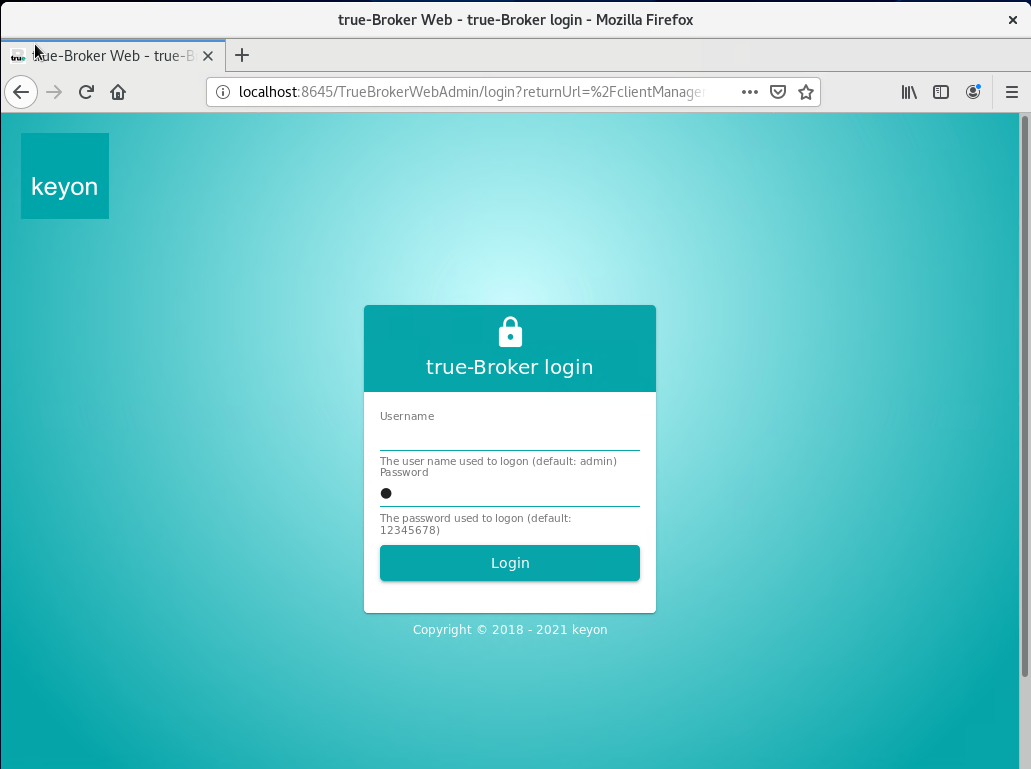
Please consult the true-Broker Web – User Manual to configure true-Broker Web.